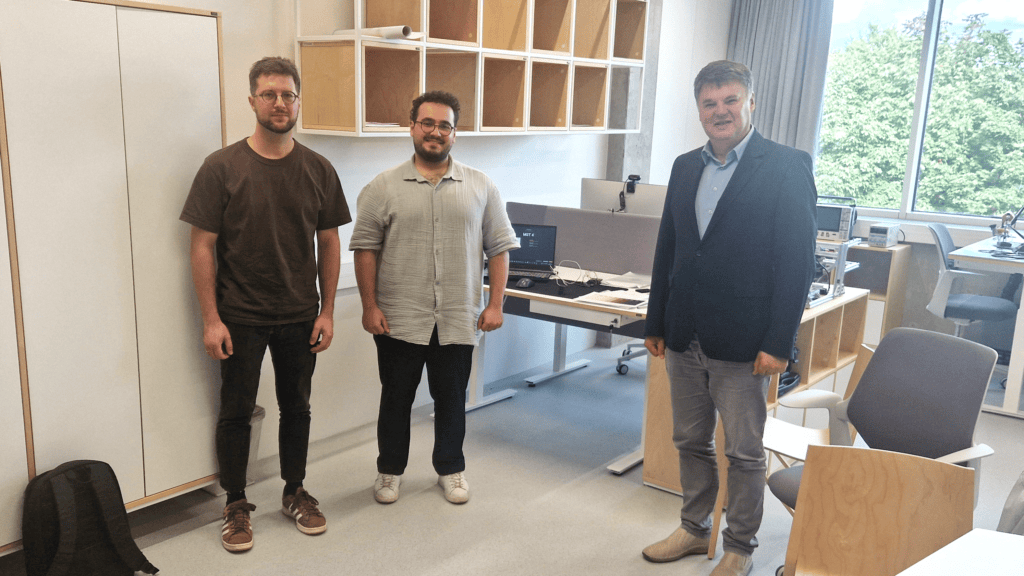
Working on the topic ‘Intern Researcher in Signal Processing and Embedded Systems’, he focused on wearable sensing for physiological monitoring technologies, with the emphasis on photoplethysmography (PPG) and on the contact force between a sensor and the skin. The student’s traineeship was supervised by prof. dr. Vaidotas Marozas.
At the beginning of the traineeship, M. Konyar investigated and calibrated various sensors for skin tone assessment, PPG signal acquisition, and contact force measurement. He then integrated several sensors into the „Nordic nRF5340” platform, developed the required embedded software, and optimised data transmission via Bluetooth Low Energy (BLE). These components were combined into a multisensor wearable prototype capable of acquiring and visualising physiological signals in real time.
During the second part of the traineeship, M. Konyar worked with more advanced PPG sensors. He analysed and reconstructed their BLE communication protocols, integrated a contact force sensor, and implemented methods for assessing PPG signal quality. He also designed and 3D-printed a mechanical enclosure for the final wearable prototype. The traineeship resulted in a fully functional multi-sensor wearable prototype, along with sensor software modules, data acquisition and visualisation software, and technical documentation.
We are pleased that talented students chose our Institute for their traineeships. Throughout his time with us, Mert Konyar worked independently, applied a systematic approach, and demonstrated the ability to solve complex technical problems. We thank him for quickly becoming involved in the work of the Physiological Monitoring Systems Laboratory and for actively contributing his ideas!